
by Patricia Reedy – In Dance
Teaching Artists: Applying the Breadth of their Skills
By Nancy Ng, Luna Teaching Artist
Segregating artistic, administrative and development departments are the typical structure of 99% of US non-profit arts organizations. My colleagues who work in such institutions experience chasms between departments and waste time bickering and competing for an even share of resources. Aside from the intention of human resource efficiency, I have never understood the acceptance of this structure.
Upon leaving graduate school I was fortunate to co-lead a small organization, Asian American Dance Performances, where there was no division between the artistic and administrative staff. I happily danced and choreographed while writing my first grants and figuring out excel spreadsheets. I always loved math and spatial relationships, which were the modalities I used to learn dance. After completing a graduate program where my portfolio included a written thesis, performance thesis, and written and oral comprehensive examinations, I was able to talk and write about dance with ease. I could make a case for my artistic work and the work of my fellow artists.
In my dual role as Director of Community Engagement and Teaching Artist at Luna Dance Institute in Berkeley, California I use the skills I honed on a daily basis – talking, writing and teaching dance. Since 1998 I have worked as a salaried employee at Luna where inherent in our mission and values there is no division between our artistic and administrative staff. This has always been a core value at Luna. We place the art of dance at the center of our work, we believe administrators should not be paid more than artists, and we believe artists bring integrity, flexibility and risk-taking to all phases of program design and implementation. Working with this model of organizational development has its challenges and successes, but after 16 years it is clear that the benefits outweigh the problems we have encountered, and solving these problems has made Luna a stronger more viable organization. As a nimble and tight team we are accountable to each other in all areas – artistic, administrative and financial; this accountability has kept our mission and vision intact and made our programs stronger.
At the National Dance Education Organization conference last week in Chicago I presented with the Luna artistic-administrative team on the theme, “Walking Our Talk: how layered collaborations lead to quality, integrity and possibility”. The panel of Luna teaching artists described our partnerships with each other and with our community collaborators eloquently and succinctly. They answered questions from the session participants with complete ownership of our organization’s mission and core values. I was able to attend another presentation by Hubbard Street Dance in Chicago and it was refreshing to see that just this past year they are also providing full-time employment for teaching artists by offering them administrative roles within the organization. Despite operating on a tight budget, our staff organized themselves as a team to apply for professional development funds to attend this conference. These teaching artist/administrators wrote grants, articulating their professional learning goals. I was also able to approach our board of directors for airplane fare because they see the value and importance of leadership development within our teaching artist staff.
The field of teaching artistry is growing by leaps and bounds. Eric Booth in the recent Guild Notes says, “ . . . this arts education asset (teaching artistry) is maturing into an identifiable field. An expertise that is relied upon broadly in public schools, in arts integration and in many community settings (e.g. healthcare, senior services, businesses, etc.) and that contributes to many innovations in arts learning, deserves recognition commensurate with its contribution.”[i] As teaching artists we can invent and power our own engine. Teaching artist leaders are running arts organizations, developing new business models while teaching and creating art. Luna has recognized this since inception. My colleague Patricia Reedy, founded Luna 23 years ago as a teaching artist, and although it has sometimes been a struggle, I am proud that we offer our teaching artist-administrators full-time employment, health benefits, paid time-off, professional development opportunities and a retirement plan.
Treating dance teaching artists as professional educators results in organic collaborations, efficiency and accountability. We are able to give teaching artists a healthy and sane structure for employment. Luna’s teaching artists work .75 to 1.0 fte. A full-time employee at Luna teaches an equivalent of 10-12 classes per week with the remainder of her time assisting, coordinating or managing a program or resource area. Cherie Hill, our communications manager is also a lead teaching artist at a school site, and she also teaches in MPACT (Moving Parents and Children Together) and Studio Lab programs. Cherie performs and choreographs (her recent choreography was presented at the Black Choreographer’s Festival). She is a parent of two children, serves on the board of directors for the Sacred Dance Guild and is a research assistant for Rennie Harris. Cherie also mentors other teaching artists as a year-long coach through our Professional Learning program. When I asked her what her thoughts were on integrating her art, teaching practice, career and family she responded, “Performing both teaching and administrative work has opened my eyes to the reality of non-profits and strengthened my understanding of Luna’s mission. When I teach in the classroom I feel confident about the curriculum and when I attend meetings or speak to press I have first-hand knowledge about the organization. Having one full-time job in the field I love enables me to take care of my family and take time off to be involved in other artistic areas.”
I started my teaching artist career 22 years ago. The creativity, fortitude, visioning and relationship skills that I used running a dance company, presenting the work of fellow choreographers and mounting full productions with a composer and lighting designer are the same skills I use in my teaching practice and in my administrative role as Director of Community Engagement at Luna. I had to chuckle the other day when my 10 year old daughter was whining about the expository essay she needed to write. She was fretting about her thesis statement and how she would present the “reasoning” to support her statement. She knows that I write a lot of grants at work, and declared, “I never want a job like yours.” I wanted to explain the complexities of what I do – how choreographing a dance is like writing an expository essay, how my artistic practice supports program development and grant-writing, how managing 10 dancers for an evening length production supports my relationship building and teaching skills, how putting together different ideas in a dance helped me juggle budgeting. The teacher in me knew she was not developmentally ready to process all of this so I just gave myself the pleasure of a laugh inside.
I am excited that arts education organizations are beginning to explore what it means to employ teaching artists as professionals. I hope they are doing so for conscientious reasons – gainful employment, building capacity and leadership for the field of arts education and honoring the integrity of art.
[i] Booth, Eric. “New Times for TAs: A Growth Spurt for Teaching Artistry.” Guild Notes Issue 3 (2014) : 1, 7. Print.
Dance Leaders Punctuate their Learning Process
This month, the first Luna Dance Education Leadership cohort completed individualized projects understand and leverage their spheres of influence, increase confidence, develop effective communication skills and jump at responsibility with integrity. Read about their journey here.
Defining Creativity and Technique
Patricia Reedy – InDance
What dance leaders say
“Success and failure are both fleeting and the work of our lives is not defined by either one.”
–Meg Glaser Teran, Dance Educator, Leadership cohort 2014
Board President Nancy Geimer Wins Wells Fargo’s $5,000 Volunteer Award
In recognition of the extraordinary commitment demonstrated by team members who dedicate their time and talent to volunteering with a non-profit organization, Wells Fargo announced that Nancy Geimer is a recipient of a Volunteer Service Award. Her steadfast contribution of 22 years of service to Luna is acknowledged through a $5,000 grant for community programs.
Co-directors Nancy Ng and Patricia Reedy are thrilled that Geimer is being honored for her service to arts education. A founding board member, Geimer has steered Luna from its humble beginnings on Park Blvd in Oakland to the full service dance composition organization it has become. As board chair, she provides outstanding leadership to fellow board members, empowering and educating them to help fulfill Luna’s mission to bring all children to dance.
Wells Fargo’s Volunteer Service Award grant supports Luna’s family dance initiative by providing funding for MPACT (Moving Parents & Children Together) at two Oakland public libraries: 81st Avenue and Cesar Chavez, as well as scholarships that enable children from our East Oakland school programs to attend after school or summer dance classes.
Click HERE to read the full press release.
Considering June in September: The Practice of Backward Design
by Katherine McGinity, Luna Teaching Artist
As a child, I loved the transition from summer to fall as it indicated the beginning of school. Crisp air, new books and a sense of excitement and possibility made this my favorite time of year. During this time, I would often daydream about the end of the school year, not because I wanted the year to pass by quickly, but because I wondered how I would be different and what I would learn over the course of the year. I tried to imagine a smarter, stronger, more skilled version of myself that would be able to look back at my “September self” and see changes. It can be more difficult to hold onto this sense of excitement as an educator diving into a new school year; it is easy to get lost in planning, shifting schedules, contracts and budgets, and all the anxieties that come with teaching. Re-centering at the beginning of the school year has become an important practice for me, as it directly benefits my students and myself.
I’ve started approaching the beginning of the school year in much the same way I did as a child—by focusing on what the end of the year will look like. How will I be changed by the experience of teaching? What do I want my students to understand deeply by June? This process asking questions and setting goals is part of “backward design”, a pedagogical tool for creating unit plans and lessons that I learned from Patricia Reedy while taking my first dance education course. By holding the bigger picture of both the beginning and the end of the year for myself and my students, I find it easier to focus on what is really important to me: practice and possibility. Refocusing on the macro view of the academic year makes the logistical micro elements shift in order of importance and become more manageable.
The idea of backward design is to identify the end goals for a class, session or population of students, determine how you will assess progress, and develop a plan that works backward from your goals. I love asking questions like: “What is really important for my students to know by the end of the year, and what are the steps I need to get them there?” Working backwards allows skills and concepts to unfold in an organic way. For example, if my end goal is having my students create their own folk dance at the end of the year, I can determine all of the collaborative skills and elements of space, time and energy they will need to understand in order to be successful in this endeavor. If I value good audience skills, I can decide on all the elements needed and place them in a flow where each skill is nested in the previous concept. This feels more coherent to me than starting at the beginning and guessing what I should do next, with no anchor. I like to think of my plans like a blueprint for a building—it makes sense to me to design the building first, determining what will make a sound foundation to support the structure. After planning, I can be confident and focused about what I am building, rather than laying bricks at the outset and hoping for something stable and beautiful.
Backward design also encourages assessment and reflection, which have become essential elements in my teaching practice. Assessments are built in, as it is necessary to have adequate evidence that the anticipated results are being met. As an educator I am able to focus on what my students need to learn, how I can measure their progress, and what I may need to shift based on their individual needs. I can also apply backward design to my own learning process as a teaching artist, by identifying my desired “destination” and creating a road map that will get me there. I encourage fellow educators as they launch into their busy year to take a moment and consider what the final days of school will look like.
Patricia Reedy & Nancy Ng Receive “Generous Heart” Award
Rhee Gold, publisher of Dance Studio Life magazine, announced that Luna co-founders, Patricia Reedy and Nancy Ng, are recipients of one of six of the first “Generous Heart” awards.
Dance Studio Life reported, “Throughout a decade of journalism, Dance Studio Life has given attention to those who do important, innovative work in dance education and service to the dance community… the efforts of the risk takers and generous hearts who have earned our respect and serve as inspiration for the entire community.”
Reedy and Ng’s award honors Luna’s nationally acclaimed family-based children’s dance programs and their advocacy of professional learning for dance educators. Through MPACT (Moving Parents and Children Together), School and Community Alliances, and Studio Lab, Luna offers developmentally appropriate, creative-based dance classes to all children. Luna’s Professional Learning services increase comprehensive, standards-based teaching practices for a wide range of educators from studio instructors to college professors to social workers.
Click here to read more about this outstanding award!
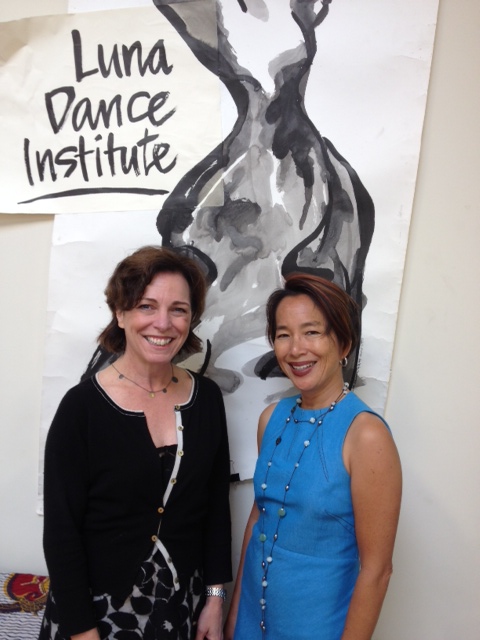
*Photo by Francis Dinkelspiel
Contemporary Dance Inspiration at Gibney Dance Center
by Cherie Hill, Luna Teaching Artist
Imagine seven different points within the body: the ankles, knees, hips, elbows, shoulders, ears and top of the head. Now explore moving these points in various fashions. Let the ankles bend and straighten, the knees circle, the hips stretch and so forth until you reach the highest point, the crown.
On Wednesday, April 16th I was fortunate to take a contemporary dance workshop with choreographer Norbert De La Cruz at Gibney Dance Center in Manhattan, NY. This workshop was one of my first “official” contemporary dance workshops and I found his style to be physically and artistically fulfilling. Prior to the class, I was oblivious of contemporary dance class structures, and while De La Cruz was teaching I was surprised at how similar his structure was to Luna Dance Institute’s (LDI). Like our lessons at Luna, Norbert’s class began with a warm-up, followed by explorations, and a deeper improvisation, and ended with performances of a student-made composition. As a dance educator and contemporary art-maker I was ecstatic to experience this method of teaching at a professional dance level. I left the studio feeling confident that our teaching methodologies at Luna are preparing our students for the contemporary world.
At LDI, many of our lessons focus on a concept that is problem-solved with the body. Two of my favorite concepts that De La Cruz introduced are connecting and disconnecting points in the body and maintaining a space hold. Utilizing two of the seven points De la Cruz defined during the warm-up, dancers chose two points to connect and disconnect, creating an imaginary line. After creating the imaginary line we took a step back to observe and then we played with the line by smothering body parts, shifting space, changing plane and switching points of contact. I thought about my students studying Laban directional scales and how I compare them to dancing different horizontal and vertical lines. I smiled and thought to myself, “Wow, my students as young as they are would really enjoy this!”
For the space hold exercise we imagined holding a sphere with two hands. The sphere could be anywhere in relation to our bodies. We could hold the sphere in front of us, on our side, behind us, high in the air etc. After playing with having both hands on the sphere we improvised holding with one hand and then with various body parts. I moved towards and away from the center, under and over it, placed the sphere at different angles, and played with the size and parts of my body that connected and disconnected. Throughout the activity I felt comfortable to dive into the improvisation and take some challenging and fun risks. Again, my mind returned to my students and contemplated on what they would do. I then realized their innocence and uninhibited actions have a strong influence on my own dance practice. I heard my inner teaching voice whisper, “How about this? Can you do it on a low level?” I was having a ball being a dancer on the floor engaged in creative dance-making.
Towards the end of the workshop each dancer provided a couple of movements based on the concepts we explored to build a class phrase. Norbert applied his beautiful knowledge of artistry to ensure all of our movements connected and flowed physically and aesthetically. After performing the phrase a few times in small groups we watched each other add improvisational moments. I was excited to see professional dancers from various dance backgrounds perform the phrase with commitment, versatility and ownership. Watching them dance together felt revealing and profound. I thought to myself, “I wish the school classroom teachers I work with could see this, because if they did, they would understand more thoroughly the great depth of thinking and dancing their students are engaged in.”
Participating in Norbert De La Cruz’s contemporary dance workshop was an enriching highlight to my trip. I had no idea the workshop would align so closely with our teaching values at Luna. I felt powerful and comfortable moving in the class and it seemed that all of us in the dance studio, no matter our dance background, were able to relate to the material, create something new and leave feeling accomplished. It is this feeling of certainty and self-knowledge that I crave for my students. Since teaching at LDI I have seen students take physical and emotional risks, and exhibit a deep understanding of their bodies in relation to space, time and energy. I believe that creative expression and improvisation are preparing them to be versatile dancers, and quick acting intelligent human beings ready to enter a forever-changing world.